
This lesson explains how to become a plumber in Colorado, step by step: registering as an apprentice, earning experience hours, passing the license exams, and keeping your license active.
Step 1: Register as an apprentice
In Colorado, anyone who works in the plumbing trade without a Colorado plumber’s license is an apprentice, and every apprentice must be registered with the state. Your employer handles the registration when you are hired, and you stay registered until you earn your first license.
As an apprentice, you work under the direct supervision of a licensed plumber. Colorado defines that as the licensed plumber being at the same job address as you, or no more than five minutes away on the same job site.
Think of apprentice registration like a learner’s permit. You can drive, and you are building experience, but a licensed driver has to be close by.
Step 2: Earn experience hours
Colorado licenses are based on documented, hands-on work experience. The state counts 163 hours as one month of full-time experience. Here is how the license levels compare:
| License | Experience required | What it allows |
|---|---|---|
| Apprentice (registration) | None to start | Work under direct supervision while earning hours |
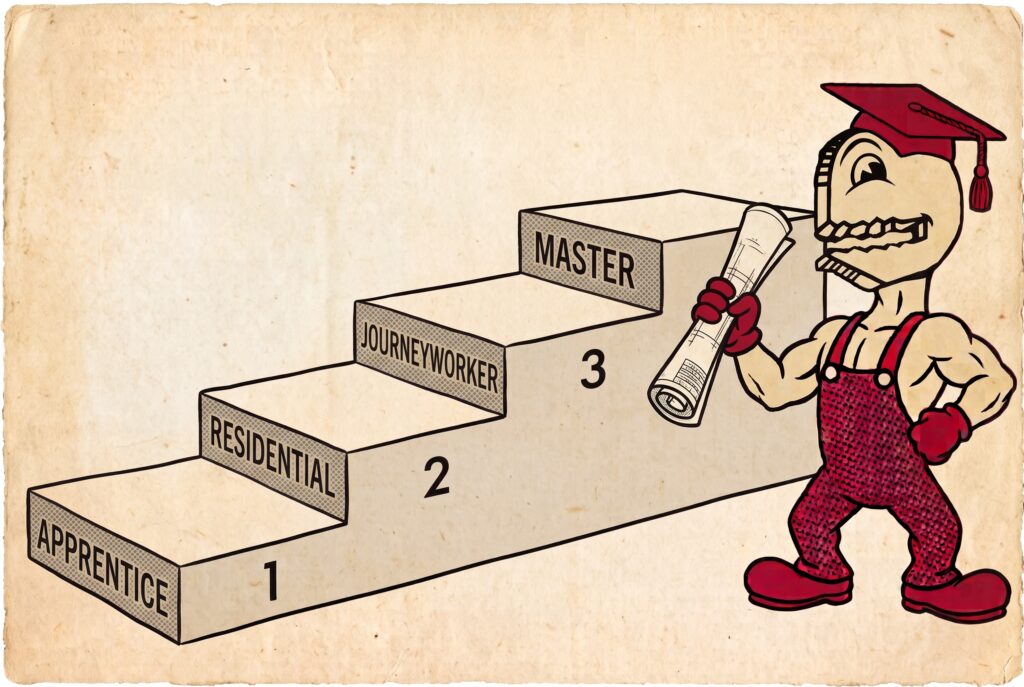
| Residential plumber | 2 years (3,400 hours) | Residential plumbing work |
| Journeyworker plumber | 4 years (6,800 hours) | Residential and commercial work under a master plumber |
| Master plumber | 5 full-time years (8,500 hours) | Plan, lay out, and supervise work; serve as a contractor’s responsible master |
You do not have to earn every license in order. Some apprentices skip the residential license and keep working until they qualify for the journeyworker exam.
Keep your own log of every job: dates, hours, and the type of work. Your employer verifies your hours, but your notes make that paperwork fast and accurate when it is time to apply.
How experience is verified
When you apply for a license, current and former employers submit an affidavit of experience confirming your hours. Applicants cannot verify their own hours. The full requirements are on the state’s plumbing applications page.
Step 3: Pass the license exam
Once the state approves your application, you take the exam for that license level. The exams test how well you know and can apply the plumbing code, so everything you learned in Lesson 1.2 applies here. Topics include drainage, venting, water supply, backflow prevention, water heaters, fuel gas, and state rules.
License exams are based on the code adopted in Colorado at the time you test. The Colorado State Plumbing Board updates the state code on its own schedule, so always study the edition your exam is based on.
The three license levels
Residential plumber
The residential license is the first license level. It covers plumbing in homes, which is where many apprentices start, including residential service and repair.
Journeyworker plumber
Colorado renamed the journeyman license to journeyworker. The requirements did not change. A journeyworker can work on both residential and commercial projects, such as commercial plumbing and new construction, under a master plumber’s supervision.
Master plumber
A master plumber can plan and lay out plumbing systems, supervise other plumbers, and work independently. Every plumbing contractor in Colorado needs a responsible master plumber. At Befort, Marcus Hayutin, the master plumber who reviews these lessons, fills that role.
Step 4: Keep your license active
Licensed residential, journeyworker, and master plumbers must complete at least 8 hours of continuing education (CE) during each year of the two-year license period. At least 4 hours in every two-year period must be about codes. Plumbers who earned their first license by exam during the current period do not need CE until after their first renewal. See the state’s continuing education page for approved topics.
Contractor registration and display rules
A plumbing business must register as a plumbing contractor with a responsible master plumber. Since June 30, 2025, contractors must also show their contractor registration number and their responsible master plumber’s license number on vehicles, billing materials, bid sheets, and their website, according to the Colorado State Plumbing Board. That is why Befort’s license numbers appear on every lesson in this course.
Never perform plumbing work in Colorado without a license or an active apprentice registration. Unlicensed work can lead to fines, and it can put customers at risk.
Where to start
Colorado does not require a degree or trade school. Most plumbers start by getting hired as an apprentice and learning on the job, often alongside classroom training. If you are ready to start earning hours, see careers at Befort Plumbing & Heating. For official forms, fees, and updates, visit the Colorado State Plumbing Board.
Want the background first? Start with Lesson 1.1: History of Plumbing.
Lesson summary
- Every unlicensed person working in Colorado’s plumbing trade must be a registered apprentice.
- Residential licenses require 3,400 hours, journeyworker licenses require 6,800 hours, and master licenses require 8,500 hours.
- Employers verify experience hours with affidavits. You cannot verify your own.
- License exams test your knowledge of the code adopted in Colorado.
- Licensed plumbers need at least 8 hours of CE each year, including code training.