This lesson covers the history of plumbing, what plumbers do today, and why the whole trade is built around one goal: protecting drinking water.
What plumbing is
Plumbing is the system of pipes, fixtures, and devices that brings clean water into a building and carries wastewater safely away. Every sink, toilet, shower, floor drain, and water heater is part of it.
That sounds simple. However, plumbing does a bigger job than moving water. It keeps drinking water separate from waste, and that separation is one of the main reasons people today live much longer than people did 200 years ago.
Think of a building’s plumbing as two separate roads. One road brings clean water in. The other road takes dirty water out. A plumber’s job is to make sure the two roads never cross.
A short history of plumbing
Rome and the word “plumber”
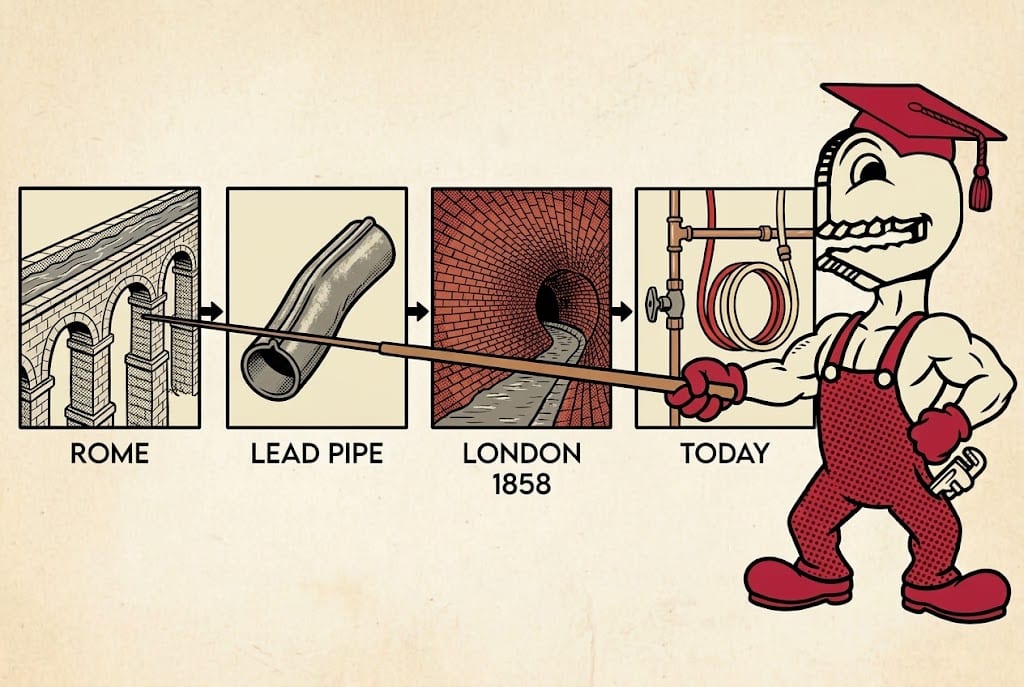
The Romans built some of the first large public water systems. Their aqueducts used gravity to carry water for miles to fountains, public baths, and latrines.
Many Roman pipes were made of lead. The Latin word for lead is plumbum, and that is where the words “plumbing” and “plumber” come from. Today, lead is no longer allowed in drinking water piping because it is toxic.
After the Roman Empire fell, much of that knowledge was lost. For centuries, most cities had no safe way to keep drinking water away from sewage.
London, cholera, and the Great Stink
In the 1800s, cities grew quickly, and waste often flowed into the same rivers people drank from. As a result, cholera outbreaks killed thousands of people in London alone.
In 1854, a doctor named John Snow traced one outbreak to a single contaminated public water pump on Broad Street. Then, in the hot summer of 1858, the River Thames smelled so bad that the event became known as the Great Stink.
London responded by building a closed sewer system, designed by engineer Joseph Bazalgette, to carry waste away from the city’s water. Other cities followed. Clean water and closed sewers became some of the most important public health improvements in history.
The plumber’s first job: protecting drinking water
There is a long-standing motto in the trade: “The plumber protects the health of the nation.” It is a reminder that a plumber’s most important responsibility on every job is keeping the potable (drinkable) water supply safe.
What is a cross-connection?
A cross-connection is any point where the drinking water system could connect to something that is not safe to drink. Common examples include a garden hose left in a bucket, a boiler, a lawn sprinkler system, or a chemical dispenser. If you want to know what is in your own home’s water, Befort offers a free water quality test.
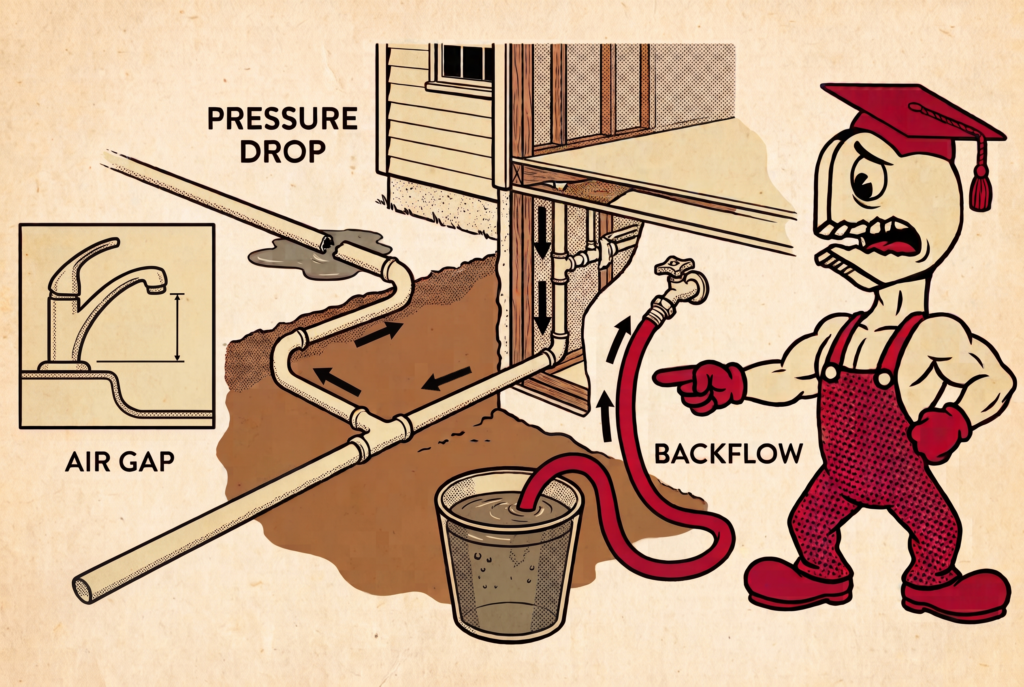
Normally, water flows one way: out of the pipe. But if pressure changes, water can flow backward. This is called backflow, and it happens in two ways:
- Back-siphonage: supply pressure drops, for example during a water main break, and suction pulls dirty water backward into the clean pipes.
- Back-pressure: pressure on the non-drinkable side, such as a pump or boiler, becomes higher than the supply pressure and pushes water backward.
Picture drinking through a straw. If the straw sits in a glass of muddy water and you suck, the muddy water comes up. Back-siphonage works the same way: a drop in pressure turns the water pipe into a straw.
How plumbers stop backflow
Plumbers prevent backflow with a few proven methods. As an apprentice, you will learn to install each one:
- Air gap: an open space of air between a water outlet and the place water can collect. Water cannot jump backward across air.
- Vacuum breaker: a device that lets air into the pipe when pressure drops, so suction cannot form.
- Reduced pressure zone (RPZ) assembly: a testable device with two check valves and a relief valve, used on higher-hazard connections.
For real-world examples of what happens when backflow protection fails, see the U.S. EPA’s Cross-Connection Control Manual.
Colorado’s plumbing code is based on the 2021 International Plumbing Code. Section 608 requires the potable water supply to be protected from contamination and explains when each type of backflow protection is required.
One missing backflow device can make everyone in a building sick. Never remove or bypass a backflow preventer, even for a short time.
Where plumbers work: the scope of the trade
Plumbing is much more than fixing leaky faucets. The trade includes several career paths, and many plumbers work in more than one over a career.
- Residential service and repair: diagnosing and fixing plumbing problems in homes. This work requires strong troubleshooting and customer service skills.
- Commercial and industrial construction: installing large systems in new buildings, like Befort’s commercial construction work at The Stables and VPP Alameda. This includes reading blueprints, installing cast iron DWV (drain, waste, and vent) piping, and coordinating with other trades.
- Hydronics and boilers: boiler systems and radiant heating that use hot water to move heat through a building.
- Specialty systems: medical gas piping for hospitals, backflow testing, high-pressure hydro-jetting, and underground sewer excavation.
Try a little of everything as an apprentice. Service work teaches you to troubleshoot, and construction teaches you how a whole system fits together. Both make you a better plumber. Ready to start? See careers at Befort.
Why plumbing codes exist
A plumbing code is the set of minimum rules for designing and installing plumbing. Codes say how pipes are sized, how much they slope, how they are vented, and which materials are allowed.
These rules were not invented to make jobs harder. Most of them exist because something went wrong in the past. People in the trade often say the code was “written in blood,” meaning each rule was learned from illness, injury, or property damage.
For example, every fixture has a trap: a curved section of pipe that holds a small amount of water. That water, called the trap seal, blocks sewer gas from entering the building. Vents let air into the drain system, so water rushing down the pipe cannot suck the trap seal dry.
A trap works like a cork made of water. The vent is what keeps the cork from getting pulled out.
Codes in Colorado
The two main model plumbing codes in the United States are the International Plumbing Code (IPC) and the Uniform Plumbing Code (UPC). Colorado’s state plumbing code is based on the 2021 IPC, with state amendments. Some cities and counties adopt newer editions or add local rules, so plumbers always confirm requirements with the local building department.
Why licensing matters
In Colorado, plumbers are licensed by the Colorado State Plumbing Board, which is part of the Department of Regulatory Agencies (DORA). License levels include residential plumber, journeyman plumber, and master plumber. Each one requires documented work experience and a passing exam.
A license shows that a plumber understands the code and can be trusted to protect public health. Lesson 1.3 covers the licensing path step by step.
Skills that make a good plumber
Successful plumbers combine hands-on skill with clear thinking. These four skills matter most:
- Math: plumbers use fractions, measurements, slope, and offset calculations every day. For example, the travel of a 45-degree offset equals the offset distance times 1.414. Unit 4 covers plumbing math in detail.
- Spatial reasoning: reading a flat blueprint and picturing how the pipes will fit inside real walls and ceilings.
- Problem solving: tracing a problem back to its cause by understanding how the whole system works.
- Communication: explaining work clearly to homeowners, contractors, and inspectors.
Lesson summary
- Plumbing brings clean water in, carries waste out, and keeps the two apart.
- Clean water and closed sewers were among history’s biggest public health improvements.
- A plumber’s first responsibility is protecting the drinking water supply from backflow.
- The trade includes residential service, commercial construction, hydronics, and specialty systems.
- Codes set minimum safety standards, and licensing shows a plumber can apply them.