This lesson explains what a plumbing code is, how the Colorado plumbing code is adopted and enforced, and how to read a code section. Every rule you learn in this course traces back to the code.
What a plumbing code is
A plumbing code is a set of minimum rules for designing, installing, and testing plumbing. It covers pipe sizes, slope, venting, materials, fixtures, water heaters, and backflow protection.
The most important word in that definition is minimum. The code describes the least a plumber is allowed to do. Good plumbers often do more, but they can never do less.
The code is the floor, not the ceiling. Meeting the code means the job is safe enough to pass. It does not mean the job is the best it could be.
Where plumbing codes came from
For most of history, there was no single set of plumbing rules. Each city made its own, and many had none at all. In the 1920s, a federal committee under then-Commerce Secretary Herbert Hoover published some of the first national plumbing recommendations.
Then, in 1933, visitors to the Chicago World’s Fair got sick from contaminated water at two downtown hotels. Investigators traced the outbreak of amoebic dysentery to plumbing cross-connections, and most accounts put the death toll near 100. The disaster pushed cities across the country to take cross-connections and plumbing codes seriously. You can read more in this history of backflow prevention and plumbing codes.
As you learned in Lesson 1.1, this is why people say the code is “written in blood.” Each rule exists because something went wrong.
Model codes vs. adopted codes
Today, most plumbing rules start as a model code. A model code is written by a standards organization and updated on a regular schedule. The two main model plumbing codes in the United States are:
- The International Plumbing Code (IPC), published by the International Code Council (ICC) and updated every three years.
- The Uniform Plumbing Code (UPC), published by IAPMO.
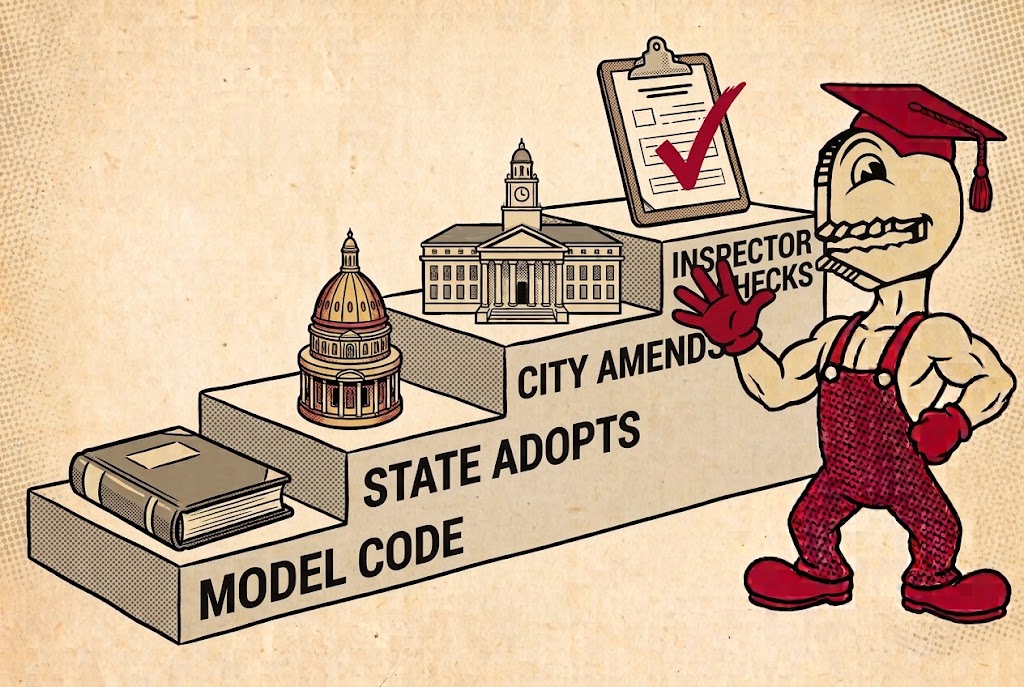
A model code is just a book until a government adopts it. Adoption is the legal step that turns the book into law. When a state or city adopts a model code, it can also make amendments: changes that fit local conditions.
How Colorado adopts its plumbing code
In Colorado, the Colorado State Plumbing Board, part of the Department of Regulatory Agencies (DORA), adopts the statewide code. The current Colorado Plumbing Code is based on the 2021 International Plumbing Code, the International Fuel Gas Code, and the plumbing provisions of the International Residential Code, with state amendments.
Cities and counties can then adopt their own version. Some use a newer edition. For example, Fort Collins adopted the 2024 International Plumbing Code with local amendments. Others keep the 2021 IPC but add their own changes.
When a local rule and the state code disagree, many Colorado jurisdictions apply the more restrictive requirement. The local building department, also called the authority having jurisdiction (AHJ), has the final word on how its rules apply.
Before every job in a new city, ask two questions: Which code edition does this city use? And what local amendments has it added? The answers can change pipe sizes, materials, and inspection steps.
How the code is organized
The IPC is organized into chapters by topic. Once you know the layout, you can find almost any rule quickly. The main chapters in the 2021 IPC are:
- Chapter 1: Scope and administration, including permits and inspections
- Chapter 2: Definitions
- Chapter 3: General regulations, including testing
- Chapter 4: Fixtures, faucets, and fixture fittings
- Chapter 5: Water heaters
- Chapter 6: Water supply and distribution, including backflow protection
- Chapter 7: Sanitary drainage
- Chapter 8: Indirect and special waste
- Chapter 9: Vents
- Chapter 10: Traps, interceptors, and separators
- Chapter 11: Storm drainage
- Chapters 12–15: Special piping systems, nonpotable water, subsurface irrigation, and referenced standards
Think of the code like a cookbook. Chapter 2 is the glossary, and each chapter after that is a different kind of recipe: one for water, one for drains, one for vents.
How to read a code section number
Code sections use a simple numbering system. Take Section 608.1 as an example:
- 6 is the chapter: Chapter 6, Water Supply and Distribution.
- 608 is the section within that chapter.
- 608.1 is the first subsection of Section 608.
- 608.1.1 would be a smaller part of that subsection.
Two more reading tips. First, many sections end with an exception, which lists cases where the main rule does not apply. Always read to the end of a section. Second, words in the code have exact meanings. In recent editions, terms defined in Chapter 2 are printed in italics, so check the definition when you see one.
Permits and inspections: how the code is enforced
A code only protects people if someone checks the work. That happens through permits and inspections.
- Permit: before most plumbing work starts, a licensed contractor pulls a permit from the local building department. For example, in many Colorado cities, water heater replacement requires a permit because of gas, venting, and pressure relief safety rules.
- Rough-in inspection: the inspector checks the piping before walls, ceilings, or floors are closed up. Drain and water lines are usually tested for leaks at this stage.
- Final inspection: after fixtures are set, the inspector checks the finished system.
Larger projects, like commercial plumbing and new construction, may have several rounds of inspection as the building goes up. Fuel gas piping has its own rules and tests, which is why gas leak detection and gas line work are handled with extra care.
Never cover plumbing before it passes inspection. If an inspector cannot see the work, they can require you to open the wall or floor back up, and the cost comes out of the job.
Why the code matters for your career
The code is the foundation of your license. Colorado’s plumbing license exams test how well you know and can apply the code. Apprentices who learn to look things up in the code book early have a big advantage at exam time.
On the job, the code is also your best defense. When a customer or contractor asks for a shortcut, “the code doesn’t allow it” is a clear, professional answer. Lesson 1.3 covers the Colorado licensing path in detail.
Lesson summary
- A plumbing code sets the minimum rules for safe plumbing. It is the floor, not the ceiling.
- Model codes like the IPC and UPC become law only when a government adopts them.
- Colorado’s state plumbing code is based on the 2021 IPC, and some cities adopt newer editions or local amendments.
- Section numbers tell you the chapter: Section 608 is in Chapter 6.
- Permits and inspections are how the code is enforced, so never cover work before it passes inspection.