

Backflow prevention devices are the safety equipment that keeps dirty water out of the drinking water supply. This lesson explains how each device works, how plumbers choose the right one, and how Colorado makes sure they keep working.
In Lesson 1.1, you learned that backflow happens in two ways: back-siphonage, when supply pressure drops and suction pulls water backward, and back-pressure, when pressure on the dirty side pushes water backward. Every device in this lesson is designed to stop one or both.
Step 1: Identify the hazard
Before choosing a device, a plumber decides how dangerous the water on the other side of the connection could be. The code sorts cross-connections into two levels:
- High hazard: anything that could cause illness or death. Examples include chemical feeders, boilers with treatment chemicals, fire sprinkler systems with antifreeze, lawn irrigation with fertilizer, and anything connected to sewage.
- Low hazard: anything that could change the water’s taste, color, or smell without making people sick.
High hazard means it could make you sick. Low hazard means it could make your water look or taste bad. The higher the hazard, the stronger the protection.
Next, the plumber asks which kind of backflow is possible. If the equipment on the dirty side can build up pressure, like a pump, boiler, or pressurized tank, back-pressure is possible. If not, only back-siphonage is a risk.
Step 2: Choose the device
Air gap
An air gap is an open vertical space between a water outlet and the flood level of a sink, tank, or drain. With nothing physically connecting the clean and dirty sides, backflow cannot happen. It is the most reliable protection there is, but it only works where water can fall freely into an open receptor.
Vacuum breakers
Vacuum breakers let air into the pipe when supply pressure drops, which breaks the suction that causes back-siphonage. They do not stop back-pressure.
- Hose bibb vacuum breaker: screws onto an outdoor faucet to protect against a hose left in a bucket or pool.
- Atmospheric vacuum breaker (AVB): installed above the highest downstream outlet. It cannot have a shutoff valve after it, because it is not designed to stay under constant pressure.
- Pressure vacuum breaker (PVB): can stay under constant pressure and has test ports. PVBs are common on lawn irrigation systems.
Double check valve assembly (DCVA)
A DCVA has two independent check valves in a row, with shutoff valves and test ports. It stops both back-pressure and back-siphonage, but it is only approved for low hazard connections, because there is no way for it to signal that a check valve has failed.
Reduced pressure zone assembly (RPZ)
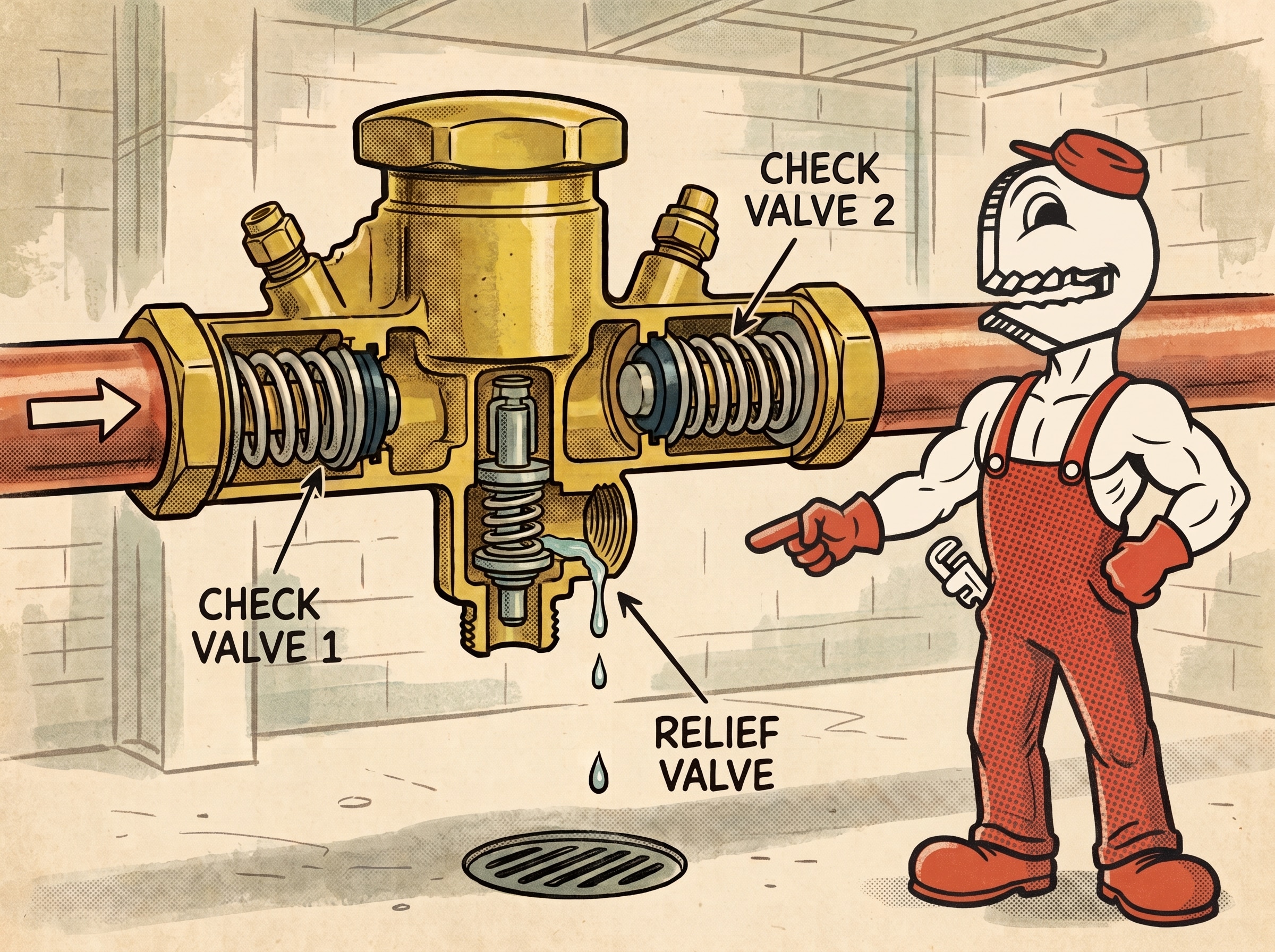
An RPZ has two check valves with a pressure relief valve between them. If either check valve leaks, the relief valve opens and dumps water out of the assembly instead of letting it flow backward. That built-in warning makes the RPZ suitable for high hazard connections with back-pressure.
If you see an RPZ dripping or spitting water from its relief valve, it is doing its job and telling you a check valve needs service. Never plug the relief port.
| Device | Stops back-siphonage | Stops back-pressure | Hazard level | Testable |
|---|---|---|---|---|
| Air gap | Yes | Yes | High or low | Inspected, not tested |
| Atmospheric vacuum breaker (AVB) | Yes | No | High or low | No |
| Hose bibb vacuum breaker | Yes | No | High or low | No |
| Pressure vacuum breaker (PVB) | Yes | No | High or low | Yes |
| Double check valve assembly (DCVA) | Yes | Yes | Low only | Yes |
| Reduced pressure zone assembly (RPZ) | Yes | Yes | High or low | Yes |
The plumbing code lists which device is acceptable for each hazard and type of backflow in IPC Table 608.1. Local water providers can require more protection than the code.
Install RPZ assemblies where the relief valve can drain freely. Never install one in a pit or below grade, where floodwater could cover the relief port.
Containment vs. isolation
Backflow protection happens at two levels:
- Containment is a backflow assembly at the service line, usually near the meter. It keeps an entire building from contaminating the public water system. Water providers focus on containment, especially for commercial buildings.
- Isolation is protection at a single fixture or piece of equipment inside the building, like a hose bibb, a boiler fill line, or a soda machine. The plumbing code focuses on isolation, because it also protects the people inside the building.
A building often needs both. Containment protects the neighbors, and isolation protects the occupants.
Testing in Colorado
A backflow assembly is a mechanical device, and springs and seals wear out. That is why Colorado requires testing. Under Colorado’s backflow prevention rule (Regulation 11, Section 11.39), water suppliers must make sure backflow prevention assemblies are tested when they are installed and every year after that by a certified cross-connection control technician.
In Colorado, a certified cross-connection control technician holds a backflow prevention assembly tester certification from ASSE or ABPA. This is a separate certification from a plumbing license, which you learned about in Lesson 1.3. Many plumbers earn both.
Local water providers run their own programs. For example, Denver Water’s backflow prevention program requires test reports to be sent to its cross-connection control office and requires irrigation assemblies to be tested when the water is turned on each season.
Testing is a good fit for a building’s preventative maintenance plan, so it never falls through the cracks. For real-world cases of backflow failures, see the U.S. EPA’s Cross-Connection Control Manual.
Lesson summary
- Start by identifying the hazard: high hazard can cause illness, and low hazard affects taste, color, or smell.
- Then decide whether back-pressure is possible or only back-siphonage.
- Vacuum breakers stop back-siphonage only. DCVAs handle low hazard back-pressure. RPZs handle high hazard back-pressure.
- An air gap is the most reliable protection of all.
- Colorado requires backflow assemblies to be tested on installation and every year by a certified technician.