What defines plumbing, and why does it matter? At its core, plumbing is the system of pipes, fixtures, and apparatuses installed in a building for the distribution of potable water and the safe removal of waterborne wastes. But its true definition goes much deeper: plumbing is the foundation of modern civilization and public health.
Historically, the absence of plumbing dictated the limits of human expansion. The Romans were among the first to engineer massive public water works, using gravity-fed aqueducts and early lead (plumbum, where the word “plumber” originates) and clay pipes to supply public baths and latrines. However, after the fall of the Roman Empire, sanitation stalled for centuries.
“Plumbers became the frontline defense against waterborne plagues.”
It wasn’t until the 19th century, during events like London’s “Great Stink” and catastrophic cholera outbreaks, that the world truly understood the link between untreated wastewater and disease. Plumbers became the frontline defense against waterborne plagues. By engineering closed sewer systems and pressurized, treated water delivery, the plumbing trade single-handedly allowed cities to safely grow into the metropolises we know today, drastically increasing human life expectancy.
“Plumbers became the frontline defense against waterborne plagues.”
The modern plumbing trade extends far beyond fixing a leaky sink. It is a highly diverse, highly technical field with multiple career pathways. As an apprentice, you must understand the different sectors you can specialize in:
Residential Service & Repair: The backbone of the trade, requiring excellent diagnostic skills, customer service, and the ability to adapt to older, unpredictable systems.
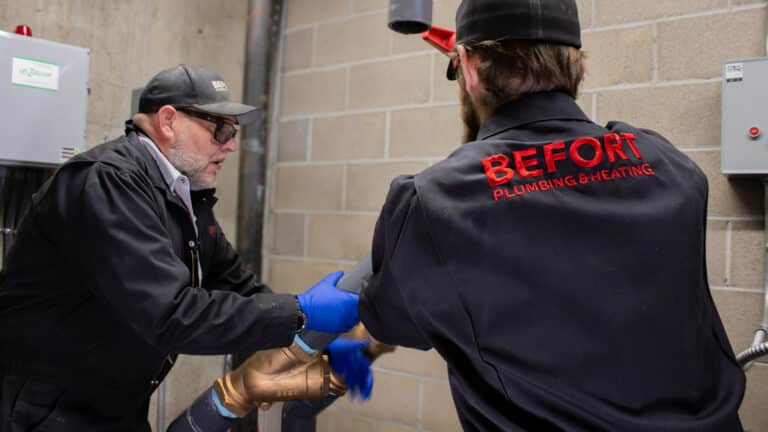
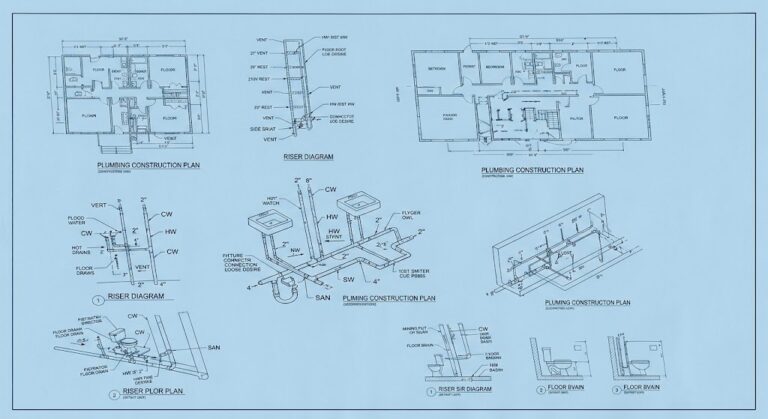
Commercial & Industrial Construction: Large-scale installations (like our work at The Stables or VPP Alameda), involving blueprint reading, heavy-duty cast iron DWV (Drain, Waste, and Vent) piping, and coordinating with other trades on active job sites.
Hydronics & Boiler Systems: Specialized heating systems that use water to transfer heat, requiring a deep understanding of fluid dynamics, pressure, and temperature controls.
Specialty Systems: This includes medical gas piping for healthcare facilities, high-pressure hydro-jetting, backflow testing, and underground excavation.
There is a well-known saying in our industry: “The Plumber Protects the Health of the Nation.”
This is not an exaggeration. Your most critical, non-negotiable responsibility on any job is ensuring the absolute safety of the potable (drinkable) water supply.
When potable water systems intersect with non-potable sources (such as a boiler, an irrigation system, or a chemical dispenser), it creates a cross-connection. If the city water pressure drops unexpectedly (back-siphonage) or the non-potable system pressure exceeds the city pressure (back-pressure), contaminated water can be sucked backward into the drinking supply.
As a plumber, you are responsible for preventing this. You will learn to properly install air gaps, vacuum breakers, and reduced pressure zone (RPZ) backflow preventers. A single mistake in physically separating supply from waste can sicken an entire building or municipality, which is why this responsibility is the cornerstone of the trade.
Why do we have such strict rules for how pipes are sized, pitched, and vented? The plumbing code is not just a book of arbitrary rules designed to make jobs harder; it is a compilation of laws written in blood and property damage.
Historical failures—such as explosive methane gas buildups in sewers or widespread illness from improper trapping—led to the creation of standardized codes like the Uniform Plumbing Code (UPC) and the International Plumbing Code (IPC). The code dictates the physics of our trade: how to properly vent a system so P-traps don’t get siphoned dry, keeping deadly sewer gases out of living spaces.
Here in Colorado, we also deal with local amendments to manage extreme freeze-thaw cycles and altitude differences. Securing your Colorado State Plumbing License through DORA (Department of Regulatory Agencies) requires thousands of documented hours as an apprentice and passing a rigorous exam. Your license is your legal certification that you understand the science of the code and can be trusted to protect public safety.
“Your license is your legal certification that you understand the science of the code and can be trusted to protect public safety.”
What separates an average pipe-fitter from a true Master Plumber? Success in this trade requires a balance of mechanical aptitude, physical endurance, and sharp mental skills.
Applied Mathematics: Plumbers use math every single day. You will need to comfortably calculate fractions, decipher pipe offset formulas (like the Pythagorean theorem for 45-degree offsets), and calculate volume, fall (pitch), and water pressure.
Spatial Reasoning: You must be able to look at a flat, 2D architectural blueprint and visualize how a complex 3D piping system will fit into a tight ceiling or wall cavity, avoiding ductwork and electrical lines.
Problem Solving: Service work requires reverse-engineering a problem. You have to understand the entire system to diagnose why one specific fixture is failing.
Communication: Whether you are coordinating with a General Contractor on a commercial remodel or explaining a repair to a stressed homeowner, professional communication is just as important as your mechanical skills.
Disclaimer: This module is provided for educational and informational purposes only. Reading this curriculum does not substitute for official on-the-job training. In Colorado, an apprentice must be employed by an actively registered Plumbing Contractor and must register with the State Plumbing Board within 30 days of starting plumbing work. To qualify for a Residential Plumber license, you must accumulate 3,400 hours (2 years) of practical experience. To qualify for a Journeyworker license, 6,800 hours (4 years) of practical experience are required. All work must be performed exclusively under the direct supervision of a licensed residential, journeyman, or master plumber.
We use cookies to improve your experience on our site. By using our site, you consent to cookies.
Manage your cookie preferences below:
Essential cookies enable basic functions and are necessary for the proper function of the website.
These cookies are needed for adding comments on this website.
Statistics cookies collect information anonymously. This information helps us understand how visitors use our website.
Google Analytics is a powerful tool that tracks and analyzes website traffic for informed marketing decisions.
Service URL: policies.google.com (opens in a new window)
Google reCAPTCHA helps protect websites from spam and abuse by verifying user interactions through challenges.